How AI Is Changing Paid Ads in 2026 (and How to Use It)
AI now writes ad variations, picks audiences, sets bids and moves budget on Google, Meta, TikTok and LinkedIn, often faster than a person could. Here's what has actually changed in paid ads in 2026, where the platforms' built-in AI helps and where it quietly costs you money, and a simple plan to put AI to work on your ad budget.
By Elizabeth Mathers, Content Writer at BuildHive, a custom software studio in Novi, Michigan, founded in 2012.
Five years ago, running paid ads meant a person picking keywords, setting bids, writing a few ads and checking the results every week. In 2026, AI does most of that work, and it does it every minute instead of every week.
That is good news if you know how to steer it, and expensive news if you don't. Here's what has really changed in paid advertising, where AI helps, where it quietly wastes budget, and how to start using it on your own ads. If you are new to the idea of AI doing business tasks, our guide to what AI automation is is a good place to start.
Want to know what your current ad budget is wasting? Get a free AI ad audit and a senior strategist will show you within 24 hours.
Key takeaways
- In 2026 the ad platforms' own AI picks audiences, sets bids and moves budget, so the job has shifted from managing ads to managing the AI.
- The AI needs three things from you: the right goal (real sales or qualified leads), enough good creative to test and clear guardrails.
- Creative is now the main lever you control, and AI can test hundreds of variations at once.
- Built-in tools like Performance Max and Advantage+ only see one platform and grade their own homework.
- A person should still review what the AI changed, and why, at least weekly.
The big shift: from managing ads to managing the AI
The ad platforms have handed more and more of the controls to their own AI. Google's Performance Max and broad match, and Meta's Advantage+ campaigns, decide who sees your ads, where they appear and how much to bid. You give them a goal, a budget and some creative, and the algorithm does the rest.
So the job has changed. Winning advertisers no longer win by clicking the right buttons faster. They win by giving the AI:
- The right goal. Real sales or qualified leads, not cheap clicks or form fills.
- Enough good creative to test, so the algorithm has something to choose from.
- Clear rules about brand voice, budget limits and what it must never say.
Get those three right and the AI works for you. Get them wrong and it will spend your budget very efficiently on the wrong thing.
5 ways AI is changing paid ads in 2026
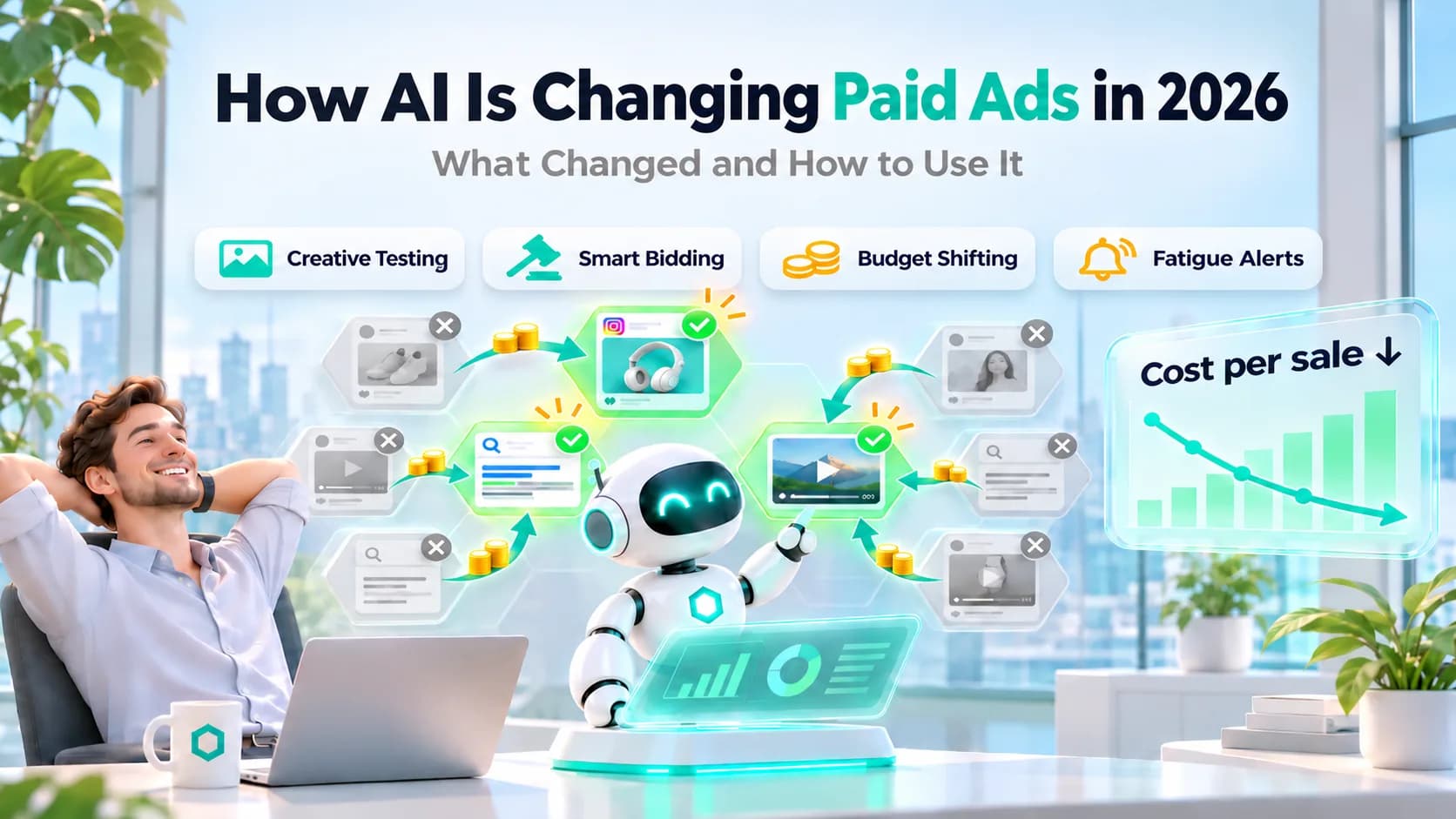
1. Creative testing at a scale people can't match
The biggest change is in the ads themselves. AI can take one offer and produce hundreds of versions: different hooks, headlines, images, video openings and calls to action. Instead of testing two ads against each other for a month, you can test hundreds at once and let the results decide.
This matters because creative is now the main thing you control. When the platform picks the audience for you, the ad itself does the targeting. A hook that speaks to busy parents finds busy parents.
2. Budget that moves every minute, not every Monday
A person checks the account once a day if you're lucky, and not at all on weekends. AI watches every ad all the time. It can pull money from a losing ad at 2 AM on a Saturday and push it to the winner before your team has had coffee on Monday.
3. Bidding and targeting are automated
Smart bidding has been around for years, but in 2026 it is the default. The platforms set a bid for every single auction based on how likely that person is to buy. Manual bidding and tight keyword lists still have a place, but for most accounts the question is no longer "should we automate bidding?" but "what are we telling the bidding to aim for?"
4. Better results from less tracking data
Privacy changes like Apple's App Tracking Transparency mean the platforms see less about each person than they used to. AI fills the gaps by modelling likely conversions and finding patterns across many signals. The catch: it needs good data from you. Sending real sales and lead quality back to the ad platforms, not just "someone filled in a form," is now one of the biggest levers you have.
5. Ad fatigue is caught before it costs you
Every ad wears out. People see it too often, stop clicking, and your cost per sale creeps up. AI can spot the early signs, such as falling click rates or rising frequency, days before the cost jump shows up in a report, and swap in fresh variations before the slump hits.
Platform AI vs. your own AI: what's the difference?
Performance Max and Advantage+ are powerful, and most good accounts use them. But they have limits worth knowing about.
| Built-in platform AI | Independent AI system | |
|---|---|---|
| Works across | One platform only | Google, Meta, TikTok, LinkedIn, email and SMS together |
| Optimizes for | The goal you set inside that platform | Your real business result, including sales from your CRM |
| Shows its reasoning? | Mostly a black box | Can log every decision with the reason |
| Moves budget between channels? | No | Yes, toward whichever channel is working this week |
| Cost | Free, built into the ad platform | A build or management fee on top of ad spend |
The platforms grade their own homework. Google's AI will not tell you that your money would do better on Meta this month, and Meta's will not tell you the reverse. That is why many businesses run the platform tools for what they are good at and add their own layer on top to compare channels and follow real revenue. That layer is usually a custom AI system connected to your ad accounts and CRM.
Where AI in ads goes wrong
AI is fast, which means its mistakes are fast too. The most common problems we see:
- Aiming at the wrong goal. Tell the AI to get leads and it will find the cheapest leads, including people who will never buy. Score ads on qualified leads or closed sales instead.
- Off-brand or risky ad copy. AI-generated ads can make claims you can't back up. Set banned words and claims, and approve new creative before it spends.
- Too little data. AI learns from conversions. An account with a handful of sales a month doesn't give it enough to learn from, and automation can make results worse, not better.
- No one watching. "Set it and forget it" is how budgets disappear. A person should review what the AI changed and why, at least weekly.
- Black-box reporting. If you can't see why spend moved, you can't tell good automation from bad luck.
The fix in every case is the same: AI does the repetitive testing, and an experienced person sets the goals, the guardrails and the strategy.
How to start using AI on your ad budget
You don't need to rebuild your marketing. Start with these five steps:
- Fix your tracking first. Make sure the platforms know about real sales and qualified leads, not just clicks and form fills. Everything else depends on this.
- Feed the machine more creative. Use AI to turn your best-performing ad into 20 to 50 variations with different hooks and visuals, all within your brand rules.
- Set clear guardrails. Decide your target cost per sale, daily budget caps, and the words and claims that are off-limits.
- Let the platform AI do what it does well, like bidding and placement, and check the results weekly against your real revenue, not the platform's own report.
- Compare channels honestly. Once a month, look at cost per sale across every platform side by side and move budget toward what is actually working.
If that sounds like a lot of moving parts, that's because it is. It is also exactly the kind of repetitive, data-heavy work AI is good at, as long as someone experienced is steering it.
What does AI ad management cost?
Using the built-in platform AI costs nothing extra beyond your ad spend. AI tools for writing ad copy and images run from free to a few hundred dollars a month. A managed service or custom AI system that tests across channels costs more, and pricing varies with how many channels you run and how much you spend.
A good rule: be wary of fees charged as a percentage of ad spend, which reward spending more rather than spending better. Look for a fixed proposal that says what will be tested and what results to expect. If you are weighing a fully custom build instead, our guide to how much custom AI costs in 2026 breaks down typical prices.
Frequently asked questions
Is Performance Max or Advantage+ enough on its own?
For many accounts they are a strong start, but each one only optimizes inside its own platform and reports on its own results. Many businesses use them for bidding and placement and add their own layer to compare channels against real revenue.
How much conversion data does AI bidding need?
More than a handful of sales a month. AI bidding learns from conversions, and an account with only a few doesn't give it enough to learn from, so automation can make results worse rather than better.
How often should someone check AI-managed ads?
At least weekly. A person should review what the AI changed and why, and check results against real revenue rather than the platform's own report.
Should I pay for ad management as a percentage of ad spend?
Be wary of it. Percentage-of-spend fees reward spending more rather than spending better, so look for a fixed proposal that says what will be tested and what results to expect.
The short version
In 2026, AI writes the ad variations, sets the bids, picks the audiences and moves the budget. Your job is to give it the right goal, plenty of good creative and firm guardrails, then check its work against real sales. The platforms' built-in AI is a strong start, but it only sees one platform and grades itself. The advertisers getting the best results pair AI's speed with a person's judgment.
Want to see where your ads are losing money today? Get a free AI ad audit. A senior BuildHive strategist will review your accounts, show you where budget is leaking and which tests to run first, with a real reply within one business day.
For weekly, plain-English takes on AI for business, follow BuildHive on LinkedIn and Instagram.
This article is general guidance. Results from AI ad optimization vary with your market, offer, budget and how much conversion data your account has.