How Much Does Custom AI Cost in 2026?
Most custom AI projects for small and mid-sized businesses cost $10,000 to $150,000, and a focused first pilot often costs less than $25,000. Here are typical 2026 prices by project type, what pushes the price up or down, the running costs most quotes leave out, and a simple way to check whether it pays off.
By Elizabeth Mathers, Content Writer at BuildHive, a custom software studio in Novi, Michigan, founded in 2012.
Most custom AI projects for small and mid-sized businesses land between $10,000 and $150,000, and a focused first pilot often costs less than $25,000. The spread is wide because "custom AI" covers everything from a chatbot trained on your FAQs to a document-processing system wired into your CRM.
This guide breaks down what you are actually paying for, typical price ranges by project type, the ongoing costs people forget, and how to start small without betting the budget. If you have not yet read our primer on what AI automation is, start there.
Key takeaways
- Most custom AI projects for small and mid-sized businesses cost $10,000 to $150,000, and a focused first pilot often costs less than $25,000.
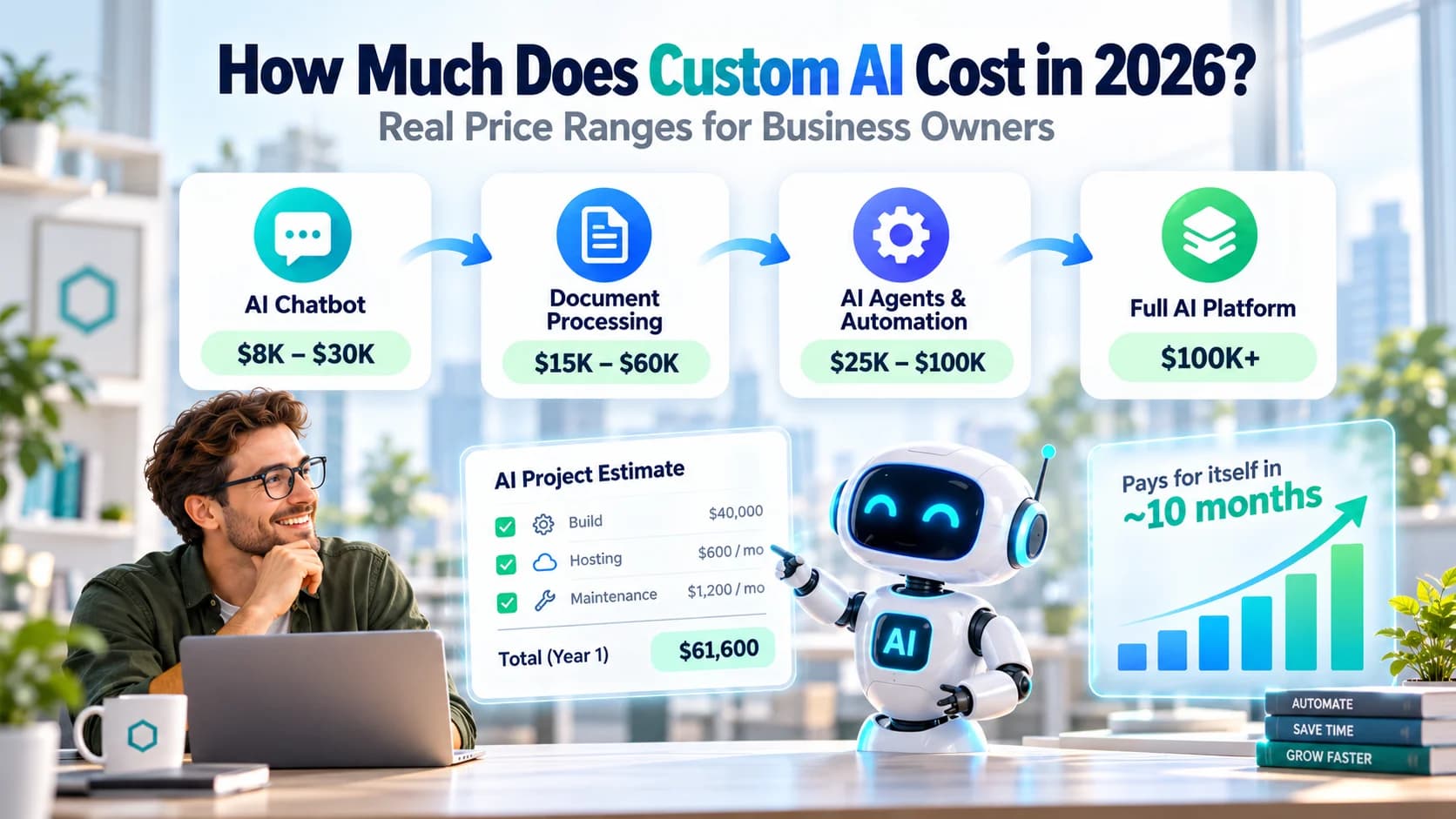
- The type of project is the biggest cost driver: $8,000–$30,000 for an AI assistant, $15,000–$60,000 for document processing and $25,000–$100,000 for AI agents.
- Integrations, data readiness, accuracy requirements, model strategy and who builds it can move the price by 3×.
- Budget another 30–40% on top of the build for year-one running costs.
- Start with a paid pilot on one workflow, measure the hours it saves, then scale what works.
What "custom AI" actually means
Custom AI is software built around your data, your tools and your workflow, rather than a subscription you adapt your process to. Off-the-shelf tools like ChatGPT Team or a Zapier AI step cost $20–$50 per user per month and work well for generic tasks. They stop working the moment you need the AI to read your contracts, talk to your CRM, follow your approval rules or run inside your own app.
In practice, most custom projects fall into one of four buckets:
- AI assistants and chatbots trained on your knowledge base, for customer support or internal Q&A
- Document and data processing, such as reading invoices, intake forms or PDFs and pushing clean data into your systems
- AI agents and workflow automation that take actions across tools (email, Slack, CRM, spreadsheets) with approval steps
- AI features inside your product, like recommendations, search, summarisation or image analysis
The bucket you land in is the biggest single predictor of cost.
Custom AI cost by project type (2026)
These are typical US agency ranges for a production-ready first version, based on the projects we scope. Treat them as planning numbers, not quotes.
| Project type | Typical cost (USD) | Timeline | Example |
|---|---|---|---|
| AI chatbot / assistant on your own content | $8,000 – $30,000 | 3–6 weeks | Support bot that answers from your help docs and hands off to a human |
| Document & data processing | $15,000 – $60,000 | 4–10 weeks | Reads incoming invoices or intake forms, extracts fields, updates your system |
| AI agent / workflow automation | $25,000 – $100,000 | 6–14 weeks | Qualifies leads from email, drafts replies, updates CRM, flags exceptions for approval |
| AI feature inside an existing app | $20,000 – $80,000 | 4–12 weeks | Smart search, summaries or recommendations added to your web or mobile app |
| Full custom AI platform | $100,000 – $300,000+ | 3–9 months | Multi-agent system with custom models, dashboards and integrations across the business |
For comparison, a mid-sized business hiring one in-house ML engineer in the US pays $150,000–$220,000 a year before benefits, which is why most companies at this stage buy a scoped project rather than build a team.
What moves the price of custom AI up or down?
Two projects in the same bucket can differ by 3× depending on five factors:
- Integrations. Every system the AI must read from or write to (CRM, ERP, email, accounting, your own database) adds scoping, auth and testing. One integration is cheap; six is a project.
- Data readiness. Clean, labelled, accessible data keeps costs low. Scattered PDFs, scanned images and inconsistent spreadsheets can add 20–40% in cleanup work.
- Accuracy requirements. An internal assistant that is "right most of the time" is far cheaper than a system making decisions about money, health or legal matters, which needs evaluation sets, guardrails and human review.
- Model strategy. Using a hosted model (OpenAI, Anthropic, Google) via API is the fastest and cheapest path. Fine-tuning or hosting your own model adds $10,000–$50,000 and is only worth it for privacy requirements or very high volume.
- Who builds it. Offshore freelancers may quote 50–70% less, but the rework and handoff costs are real. A senior US-based team costs more per hour and typically delivers in fewer hours with less risk.
The cheapest way to lower the number is to cut scope, not quality: fewer integrations, one workflow, one team using it first.
The ongoing costs nobody quotes
The build price is roughly 60–70% of what you will spend in year one. Budget for:
- Model API usage: $50–$2,000+ per month depending on volume. A support bot handling 5,000 conversations a month typically runs $100–$400.
- Hosting and infrastructure: $50–$500 per month for cloud servers, databases and vector storage.
- Maintenance and monitoring: 10–20% of the build cost per year. Models get updated, prompts drift, integrations change their APIs.
- Improvements: the first version teaches you what the second should do. Plan a small follow-on budget rather than treating launch as the finish line.
A $30,000 build therefore tends to cost $40,000–$45,000 in its first year all-in. Any proposal that does not mention these numbers is leaving them for you to discover later.
Is it worth it? A simple ROI check
Custom AI pays off when it removes repeated human hours or unlocks revenue you cannot capture by hand. Run the maths before you talk to anyone:
- Pick one task. Count how many hours a week your team spends on it.
- Multiply by the loaded hourly cost of the people doing it (salary + benefits ÷ hours).
- Assume the AI handles 60–80% of that work, not 100%.
- Compare the yearly saving to the build cost plus the year-one running costs above.
Example: two staff spend 15 hours a week each processing intake forms at a loaded cost of $40 an hour. That is $62,400 a year. A $35,000 document-processing build that handles 70% of it saves about $43,000 in year one and pays for itself in roughly 10 months, with the savings compounding every year after.
If the task saves less than $20,000 a year, an off-the-shelf tool is usually the better buy.
How to start without a six-figure budget
The lowest-risk path is a paid pilot: one workflow, one team, four to six weeks, $10,000–$25,000. A good pilot proves three things before you spend more:
- Accuracy on your real data, not a demo dataset
- Adoption: does the team actually use it, and where does it get in the way
- The true running cost at your volume
If the pilot works, the second phase extends it to more teams and integrations with the numbers already de-risked. If it does not, you have spent a fraction of a full build and learned exactly why.
This is how we scope every custom AI engagement at BuildHive: a short discovery call, a fixed-price pilot, then a roadmap based on what the pilot showed.
Frequently asked questions
How much does a custom AI chatbot cost?
A chatbot or assistant trained on your own content typically costs $8,000 to $30,000 and takes 3 to 6 weeks to build. Most of the range comes down to how many systems it connects to and whether it hands conversations off to a person.
How much does custom AI cost to run each year?
Plan for roughly 30 to 40% on top of the build price in year one. That covers model API usage ($50 to $2,000+ a month), hosting ($50 to $500 a month) and maintenance at 10 to 20% of the build cost per year.
Is it worth fine-tuning or hosting your own AI model?
Usually not for a first project. Fine-tuning or hosting your own model adds $10,000 to $50,000 and mainly pays off for strict privacy requirements or very high volume; a hosted model through an API is the faster, cheaper path.
When is an off-the-shelf AI tool the better buy?
When the task would save less than $20,000 a year, or when the work is generic and doesn't need your data, your tools or your approval rules. Tools like ChatGPT Team cost $20 to $50 per user per month.
The short version
Expect $8,000–$30,000 for an AI assistant, $15,000–$60,000 for document processing, $25,000–$100,000 for agents and automation, and $100,000+ for a full platform. Add 30–40% for year-one running costs. Start with a scoped pilot, measure the hours it saves, and scale only what works.
Ready to put a real number on your project? Tell us about it and we'll send back a scoped estimate within one business day, or browse our custom AI work to see what similar builds look like. You can also read how our custom AI solutions team runs discovery, pilots and full builds.
For weekly, plain-English takes on AI for business, follow BuildHive on LinkedIn and Instagram.
Figures are typical 2026 US market ranges from projects BuildHive has scoped and are approximate. Your quote will depend on scope, integrations and data readiness.